Welcome to Bad Advice, a series I’m writing that I wanted to call Bullshit Wisdom but chickened out because of Teh Algorithms.
Sometimes advice is just bad. Sometimes advice is good but it strikes at our insecurities so we react against it. And sometimes it’s both.
With all of these posts, I understand that people’s feelings on the advice in question may differ. I once read an interesting internet debate on whether the phrase “if a job’s worth doing, it’s worth doing well” or “if a job’s worth doing, it’s worth doing poorly” was more empowering. And I can see the virtue of both. On one hand, if you’re going to do something, why not do it properly? On the other hand, sometimes poorly done is better than not done at all.
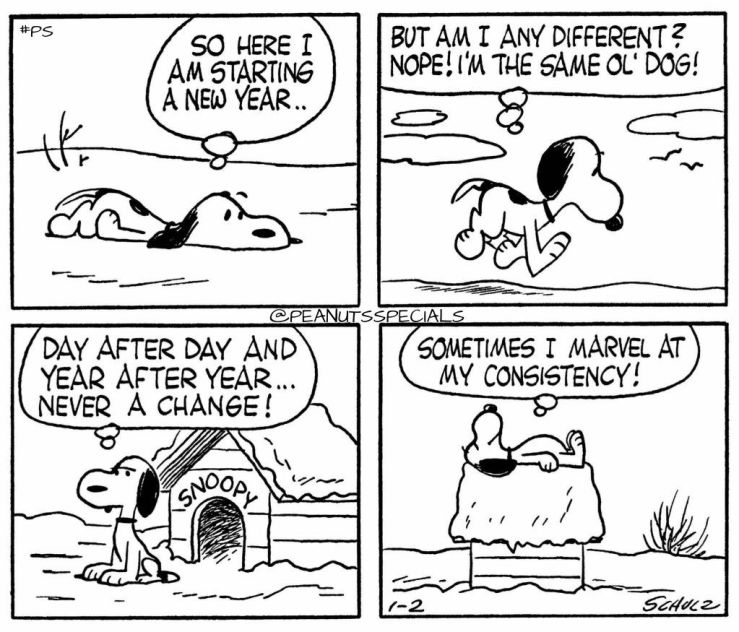
Maxims on consistency get under my skin because I don’t feel very consistent. I struggle to build habits. I get bored with bland repetitions. I know I can be inclined to leap on a new idea too quickly and abandon a project mid flow.
Consistency of approach can be useful, both with ourselves and others. I don’t condemn advice on consistency. I’ve found that I’ve been able to make progress when I’ve set time apart, made goals, taken some small habit and tried to do it every day. Young me thought she hated routine. It can be easy to feel bored, especially when the routine of your day is decided by others, as it is for much of the time when you are a child or a teenager. But I found myself struggling so much when the external reminders, the enforced routines were removed. I had resented – and don’t we all – habits that had actually been helping me thrive. You know how every child would love no bedtime, no homework, to just eat whenever they feel like it, gaming all day? It’s a horrifying discovery to realise that your dream lifestyle is actually possible but you hate it. Suddenly you need something else.
And so often, making that something else that leads to a more meaningful existence, a greater sense of purpose and control – that needs consistency.
Except…
Consistency isn’t the most important thing in itself
Consistency is a tool. But it is only that. When you have a hammer, every job looks like a nail – and consistency can also be a blunt instrument when faced with the very inconsistent nature of living. Sometimes it can even be a cage rather than a scaffold.
For starters, let’s address the obvious. Inconsistently doing a good thing is better than consistently not doing it.
Brushing your teeth between 2-3 times a week? Better than consistently never brushing your teeth. Call your mother once or twice a month? Then forget, then three times? Better than consistently never calling her. Assuming you have a mother worthy of being called. (Obviously, reminder of previous maxim that “some people are assholes”. Unfortunately, even mothers, sometimes. Not mine though. Love you, Mum).
Secondly consistently doing a bad thing is worse than inconsistently doing it. Which includes “too much of a good thing”.
I told my dentist proudly that I had bought a firm toothbrush. They said it was a poor choice for my gums. Brushing your teeth excessively is bad for them. If the consistent action is harmful in excess, or harmful in itself, no amount of extra consistency will make that better.
Being told to be consistent does not, of itself, make you more consistent
The tool we all need, what, for me, is a contender for the most important thing? Reflection.
So instead of going “I must brush my teeth more”, try curiosity. Why aren’t you brushing your teeth? Do you forget? Do you dislike your toothpaste? Do you need a reminder? Would it help to look up oral hygiene and inspire yourself to do better? Or would it help to get nice new toothbrush that you would look forward to using?
I am a big fan of apps that give you a reminder on those little habits – the ones I’ve used are Daylio, TickTick and Finch (not sponsoring this post) and they have helped me a lot. I also recommend setting a reminder using a calendar app or scheduling a text message to yourself. Or make a sticker chart if you want. If something helps, do it.
Do you need to be more consistent, or do you need to try something else?
Because sometimes whatever you’re doing consistently doesn’t work.
In the words of a Narcotics Anonymous member, who hit it out of the park so thoroughly people attributed her words to Einstein, “Insanity is just doing the same thing over and over, and expecting a different result.”
This is particularly true for addiction, of course – repeatedly doing something that leaves you feeling miserable, ashamed, that damages your relationships and bank account. This is why it’s so important for people to get help when habits become addictions – I recommend this episode of Late Bloomers if that resonates with you.
But it can be true for positive changes we are trying to make too. Every morning you set your alarm for 4.30 am so you can get up and have a run… and every morning you press “snooze” and wake up feeling bad about yourself at 7 or later. Every day you try to drag your child through some routine meant to edify them and yourself – maybe bribing them to eat their veg, or taking them to a club they hate to help them open up to others, but your heart isn’t in it so despite trying for weeks it isn’t making a difference. Every day you try to make sure your work is finished for the day but you end up staying later and later, getting more and more tired, and somehow never getting ahead. What you need at that point isn’t more consistency, it’s a change in approach.
It’s okay to try things for the short term
We aren’t robots. Our initial intention behind a self-improving goal is (hopefully) a good one, but we can’t succeed if we consistently do things that don’t work. What we need is an experimental approach.
If you’ve ever planned a scientific experiment, you will know that there are some things you need to repeat, there are some things you need to keep the same, and, crucially, there are some things you need to change. One result may be a fluke – you need to try something more than once for a more accurate picture – that’s where consistency comes in. But you also need something to compare to. You might be searching for an optimum, a best response. If an alarm at 4.30 am has never motivated you to go for a run, chances are that it won’t magically start. So try some other things. Try them more than once. Tweak them. Vary them. Be curious. Reflect. Find out what works best for you.
Novelty is the spice that consistency needs to keep it interesting
Sometimes we all get bored. I mentioned in a previous post that I did the Couch-5k running program. I enjoyed running outside in the sunshine. But as winter approached, I dreaded the thought of running at night, when it might be icy, when it was pouring down with rain. So, I joined a gym. But I thought the treadmill might get a bit boring… So, I installed Zombies Run on my phone (also not a sponsor) which is essentially a gamified running podcast. It kept things interesting. The stories were good and as a writer I really appreciated how they handled the idea that “you” (the listener) were the main character although you were mainly there to run and given how chatty everyone else was, you were clearly a strong silent type. I didn’t keep doing it forever – in fact, given the horror theme I found it too distracting when trying to run outside the following spring. But it served its purpose over the winter.
A slip isn’t an instant fail
One of the most pernicious ideas about habits is the idea that if you break it once, you have failed, and you might as well give up.
I know a “streak” or a run of days of success can be powerful motivators for many, but for many of us, especially those of us who feel like we are inherently inconsistent, that first day that we slip, that healthy habit missed once becomes the sign that we should just give up. We have failed. We always knew we were inconsistent and here’s the proof.
But here’s the thing… It turns out that we don’t actually have to give up. We don’t have to settle into having consistently low expectations of ourselves, even if we’re only inconsistently living up to the higher expectations. Growth is messy and we make mistakes. We can take that as part of the process rather than proof that we’re not cut out for it.
Sometimes you just need a break
There’s a reason that we have things like cheat days, casual Fridays, non-uniform days at school, bank holidays, and even celebrations that allow for “anti-social” behaviour like trick-or-treating. None of us can be perfect all the time. Having days where certain rules don’t count can give us the energy to follow them on other days. And we can’t just work all the time. Spending time resting and letting yourself be a person rather than a productivity-filled entrepreneur, executive, activist, leader or parent – that’s important. In fact, I’d go so far as to say we should all rest consistently.
What’s the most important thing?
Feeling like an inconsistent person, something almost certainly exacerbated if not caused by my ADHD, I’ve often found that being told to “be consistent”, as if it is a simple, easily achievable step, has left me feeling defensive.
But here’s the thing.
• I can be consistently kind.
• I can prioritise treating people with even-handed fairness.
• I can do what I say I’ll do.
And a big part of this is just learning how to keep things simple… Not a simple process in itself, but one that is rewarding. Learning when to let go of things because they don’t actually matter. Learning from mistakes and promises made rashly to repair relationships and make more reasonable expectations so I can live with more integrity. Reminding myself when consistency is important but bringing some novelty to it so I can enjoy it more.
What sort of things in your life do you think need to be consistent? Is there anything that you’re doing consistently that you would like to change?
If you enjoyed this post, or found it helpful, please share it on. You can also subscribe by adding your email to the link on the right of my homepage.

 Helen Speaks
Leave a comment